What is scaling, and why we do it
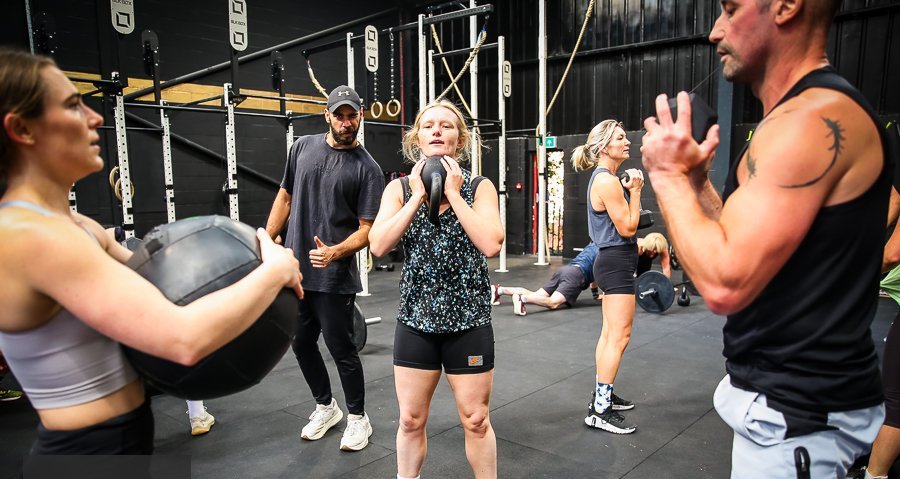
Every workout at WSX is written once and then adjusted to the person doing it. That is scaling: same intent, same stimulus, different load, range or pace. The person next to you might be lifting twice what you lift or half of it, and you are both doing the session properly.
If you have never trained in a coached gym, this is the single idea that makes everything else make sense. It is why a 24-year-old rugby player and a 58-year-old who has not exercised since school can stand on the same floor at 6am and both leave having had a good hour.
What a coach is actually changing
A workout has a purpose. Sometimes it is heavy and slow, sometimes it is eight minutes of hard breathing, sometimes it is a skill practised under light fatigue. The coach's job is to protect that purpose for each person in the room. The levers are simple:
- Load. The bar, the dumbbell, the ball. Lighter or heavier so the set feels the way it is meant to feel.
- Range. A box under the squat, a band on the pull-up, a raised handle for the push-up. Same movement, a range you can own today.
- Volume. Fewer reps or rounds so the session ends on time and on purpose, not twelve minutes after everyone else.
- Movement. A ring row instead of a pull-up, a step-up instead of a box jump. The pattern stays, the risk comes down.
- Pace. Told to hold back on the first round so the fourth one is still training rather than survival.
None of that is improvised. It is decided before class, written on the whiteboard as options, and then adjusted in the room when the coach sees you move.
Scaling is not the beginners' version
This is the part people get wrong. Coaches scale sessions for people who have trained for years, because bodies have histories: a shoulder that needs a different angle, a back that wants a lighter week, a competition that wants a heavier one. The strongest people in the gym scale more often than the newest, because they know exactly what they are trying to get out of the hour.
The letters on the board (RX, scaled) are a description of the intended stimulus, not a ranking. We wrote more about that in how to read a workout.
What it means for you
You do not need to be fit before you start. That sentence is not marketing; it is a direct consequence of how the sessions are built. Before your first class we assess where you are, in the gym or over a call, so your first few sessions are set at your level rather than the whiteboard's.
You will also never grind through something your body is not ready for. The coach decides with you, session by session. If today is not your day, they will say so before your back does. Over months the scaling moves: the box gets lower, the band gets thinner, the bar gets heavier. That movement is the progress, and it is visible every week.
What it looks like in a WSX Train week
WSX Train runs three coached classes a week. In a typical week one of them is strength-led, one is conditioning-led and one is skill-led. Each is scaled on the day. A new member might squat to a box with an empty bar on Monday while the person beside them squats 120kg; on Wednesday both might row the same distance at very different paces; on Friday both practise a handstand, one against the wall and one freestanding. Same programme. Same coach. Same hour.
Questions
Will I be the least fit person in the room?
Possibly, for a few weeks, and nobody will mind, because everyone in the room started there. The session will be scaled so you finish it properly rather than survive it.
Does scaling mean I will not get fitter as fast?
The opposite. Training at the right level is what makes you fitter; training above it makes you sore, then injured, then absent. Consistency beats intensity, every time.
Who decides what I scale to?
The coach, with you. Options are on the board before class and the coach adjusts them once they see you move. If something feels wrong, say so during the session, not after it.
Coached at WSX, Winchester
WSX Train is where this is coached, three times a week.
Written by
Lefty · General Manager · CrossFit Level 2
General Manager at WSX. In the fitness industry since 2014 with a Bachelor’s and Master’s in Physical Education and Sports Science, CrossFit Level 2 Trainer. Found CrossFit in 2015 and never left; WSX has been his second home since 2022.